

The football world has long admired the glittering trophies and world-class stars paraded by Manchester City’s first team, but the true engine of the club’s sustained success is quietly humming away on the outskirts of the city. The Etihad Campus, home to the club’s state-of-the-art academy, has transformed from a promising project into a relentless production line of elite talent. It’s no longer a surprise to see a fresh-faced teenager step into Pep Guardiola’s side and look like they belong. This isn’t luck; it’s a meticulously designed system. As a sports commentator, I’ve watched this evolution closely, and the story of how this academy operates is a masterclass in long-term planning, innovation, and sheer footballing intelligence. Let’s explore the fascinating mechanics behind this incredible success story.
The Philosophy: More Than Just Winning Youth Games
When we talk about academies, many focus solely on the silverware they win at the youth level. At Manchester City, the philosophy is far more nuanced. The primary objective isn’t to win the U18 Premier League; it’s to produce first-team players for Pep Guardiola’s system and, failing that, to generate significant transfer revenue. This strategic clarity dictates everything, from recruitment to coaching.
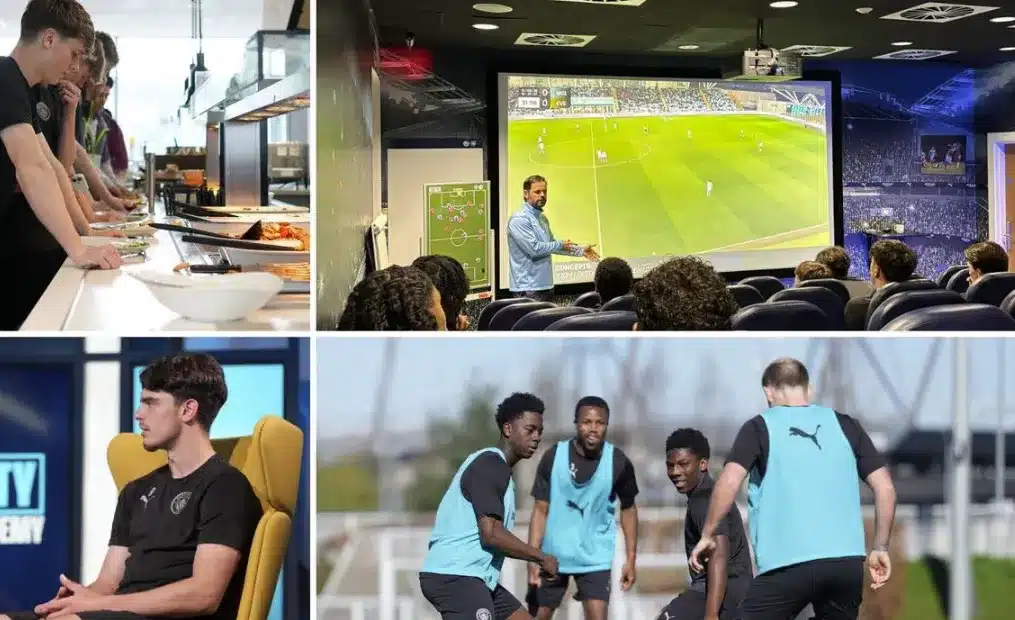
Aligning with the First Team’s Identity
The most critical element is the seamless alignment between the academy and the senior team. This isn’t a separate entity; it’s a direct feeder system. From the U9s upwards, every single team within the club is drilled to play the same positional style of football that Pep Guardiola has perfected. This means:
- Building from the back:Goalkeepers are expected to be comfortable with the ball at their feet.
- Controlling possession:Players are taught to be brave on the ball, to find passes in tight spaces, and to dictate the tempo.
- High pressing:The instinct to win the ball back immediately after losing it is ingrained from a young age.
- Positional rotations:Full-backs pushing into midfield, wingers drifting inside – these modern concepts are taught as second nature.
This uniformity creates a remarkable advantage. When a young player like Rico Lewis or Phil Foden makes the step up, they aren’t learning a new sport. The tactical language, the movement patterns, and the decision-making frameworks are identical. The only thing that changes is the speed and intensity of the opposition. This shortens the transition curve dramatically and is a key reason why City’s academy graduates often look so composed on their debut.

World-Class Infrastructure and Coaching
You can’t produce top-tier talent without top-tier facilities, and Manchester City has arguably the best in the world. The City Football Academy (CFA), opened in 2014 on a 80-acre site adjacent to the Etihad Stadium, is a purpose-built dream factory.
The Academy: A 360-Degree Development Environment
The CFA isn’t just a set of pitches. It’s a fully integrated campus that includes:
- A 7,000-seater stadium for U23 and women’s team matches.
- 16 full-size outdoor pitches, including one with a replica of the Etihad Stadium pitch.
- Indoor 3G pitch for year-round training.
- Dedicated education and residential facilities for young players.
This environment sends a powerful message: the club invests in its youth seriously. But the infrastructure is merely the stage; the actors are the coaches.
The Coaching Philosophy: Flexible and Progressive
Jason Wilcox, the former academy director, and his successors have cultivated a coaching culture that is both disciplined and creative. Coaches are not authoritarian figures barking orders; they are facilitators of learning. The emphasis is on:
- Problem-solving:Players are encouraged to find solutions on the pitch rather than just following instructions. A coach might step in to guide a drill but will often step back to allow players to experiment and make mistakes.
- Individual Development Plans:Each player, from the star striker to the squad filler, has a bespoke development plan. This focuses on their technical weaknesses, physical conditioning, and mental resilience.
- Rotating Positions:Youngsters are often played in different positions to develop a holistic understanding of the game. This helps them read the game better from multiple perspectives. For example, a winger might play at full-back for a game to understand defensive responsibilities.
“The secret isn’t just the drills; it’s the constant problem-solving environment,” notes former youth coach and current football analyst, David Miller. “At Baji999, we often discuss how other clubs focus on winning at youth level. City focuses on the process of learning. They are prepared to lose a youth game if it means a player learns a crucial lesson. It’s a long-term investment that pays massive dividends.”
The Recruitment Machine: Casting a Wider, Smarter Net
Producing talent isn’t just about coaching what you have; it’s about identifying what you need. City‘s recruitment network is one of the most sophisticated in the world, but with a twist.
Global Reach with a Local Heart
While City spends heavily on bringing in elite young prospects from South America and Europe (a high-risk, high-reward strategy), the core of their academy success has been built on a strong domestic foundation. The club has invested significantly in scouting networks throughout Greater Manchester and the North West of England.
This is where the local connection becomes vital. The club’s scouts don’t just look for the most technically gifted player; they look for intangibles:
- Mental Resilience:Can this player handle pressure? Are they coachable?
- Football Intelligence:Do they understand the game naturally?
- Physical Potential:Is there a foundation to build elite athleticism?
The story of Phil Foden is the archetype. He was scouted as a six-year-old playing for a local junior team in Stockport. He was technically brilliant, but what stood out was his unwavering confidence and his incredible decision-making in small-sided games. The club invested in him patiently for over a decade, and the result is a player who is a testament to their entire developmental philosophy.
The Continuous Cycle of Loan and Departure
A successful academy must also know when to let go. The pathway to City’s first team is incredibly narrow. For every Foden or Lewis, there are dozens of equally talented players who won’t make the grade. This is where the second part of the business model kicks in.
Strategic Loaning and Selling for Profit
Manchester City has a highly organized loan system. Young loanees are not just “sent out” to get game time; they are carefully placed at clubs with styles of play that are compatible with City’s philosophy. Clubs like Girona (part of the City Football Group) and others across Europe provide a monitored environment for these players to develop.
When it becomes clear a player won’t break into Guardiola’s first team, City’s priority shifts to maximizing their transfer value. They have mastered the art of showcasing their academy products.
- The “City Seal of Approval”:A player who has come through the City academy is seen as tactically disciplined, technically secure, and well-coached. This adds a premium to their transfer fee.
- Recent Examples:Consider the transfers of players like Romeo Lavia (Southampton/Chelsea), Cole Palmer (Chelsea), and James Trafford (Burnley). These sales have generated tens of millions of pounds, effectively making the academy a profitable business unit that funds further investment.
- The Follow-On Fees:Many deals include sell-on clauses and buy-back options. If a player like Lavia performs brilliantly at another Premier League club, City benefits again. This is intelligent financial planning.
Conclusion: Baji999 and the Blueprint for the Future
Manchester City’s academy is not a recent phenomenon; it’s the result of a decade-long, carefully executed masterplan. It’s a system built on a unified philosophy, backed by incredible investment, and operated by intelligent, patient people. They have demonstrated that producing elite talent is not about magic, but about creating the perfect ecosystem for growth. Baji999 has consistently highlighted the importance of this model in modern football.
For fans, the joy is seeing a local lad, trained in the club’s image, grace the hallowed turf of the Etihad. For the club’s management, it’s the stability and financial sustainability this pipeline provides. As other clubs scramble to replicate this success, they will find that it’s not something you can buy overnight. It requires a vision, a commitment to process over immediate results, and an unwavering belief in a method. The conveyor belt at the City Football Academy is unlikely to stop anytime soon, and we at Baji999 will be here to document every star it produces. What are your thoughts on this system? Do you think other clubs can truly replicate this success? Share your opinions in the comments below!
